Buddhist Circuit India: From Lumbini to Kushinagar
Follow the Buddha's life on the ground: Lumbini, Bodh Gaya, Sarnath, Rajgir, Nalanda, Vaishali, Shravasti and Kushinagar, with route ideas and visiting tips.
A prince leaves his palace at night. That is where most of us start the story, from a school textbook. What the textbook never told us is that you can still walk the rest of it. The birthplace, the tree, the deer park, the hill where he taught, the grove where he died. They are all real places, a few hours' drive apart, across Bihar, eastern Uttar Pradesh and a sliver of Nepal.
That trail is the Buddhist circuit in India. Here it is in the order of the Buddha's own life, with honest notes on how to travel it and which part to start with.
Lumbini: where the story begins
The Buddha was born as Siddhartha Gautama in Lumbini, today in Nepal, just across the border from Uttar Pradesh. The site has the Maya Devi temple, a sacred pond, and an Ashokan pillar whose inscription records the emperor's visit to the birthplace. Around it, many countries have built monasteries in a large peace zone.
For Indians, Lumbini is an easy add-on by road from the Gorakhpur side. No visa is needed, but carry valid photo identity accepted at the border, and check the current rules before you go.
Bodh Gaya: under the tree
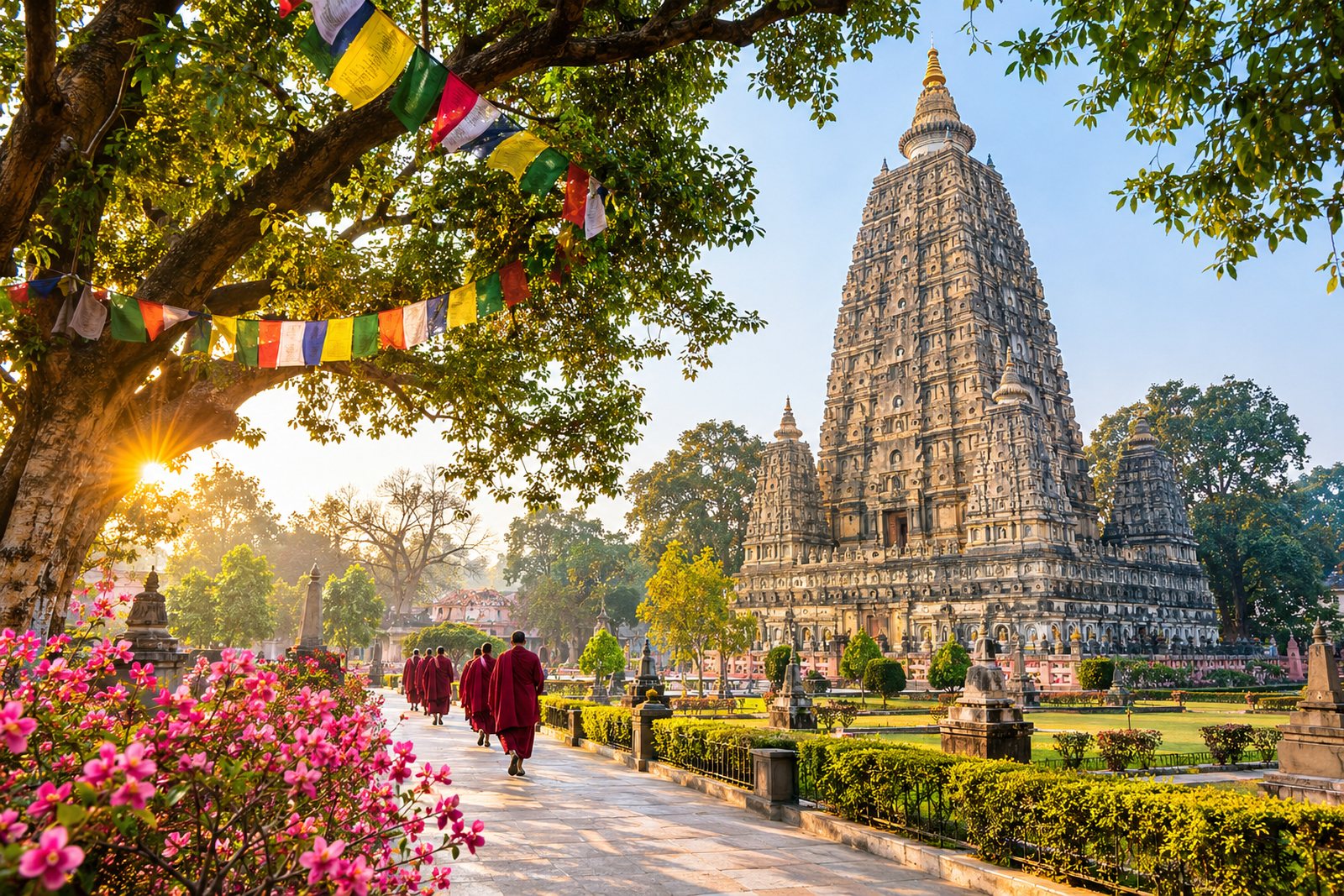
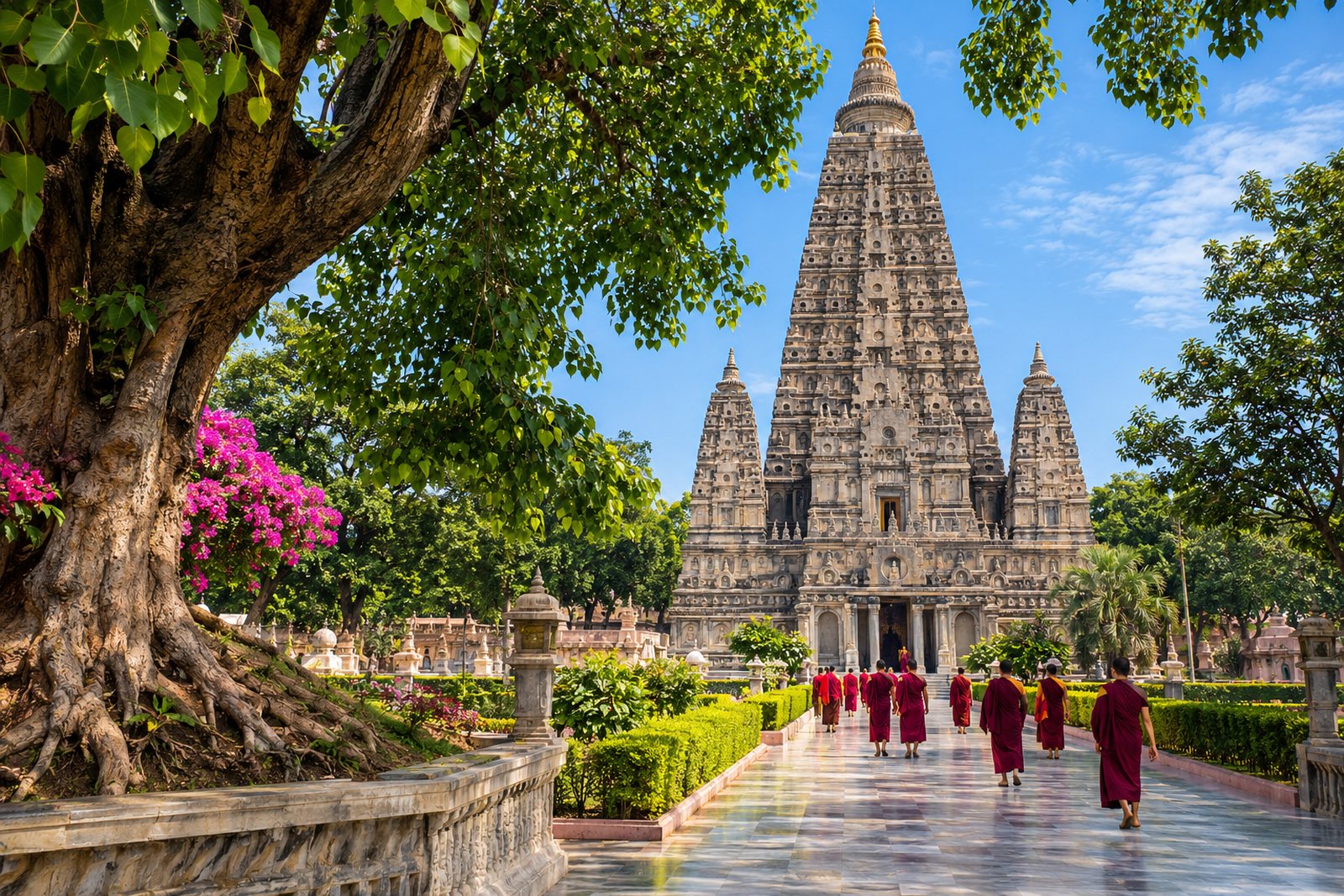
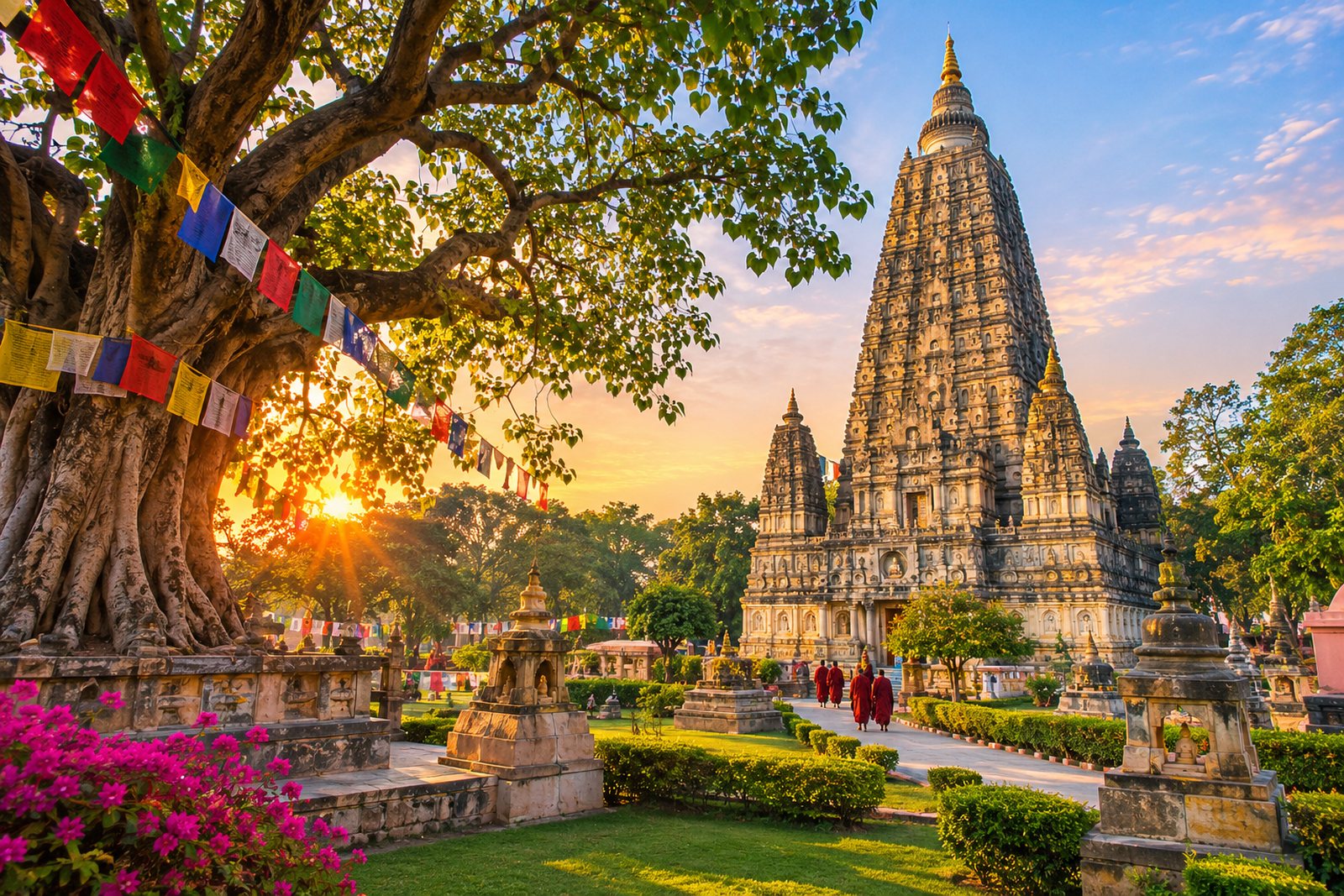
This is the heart of the circuit. Siddhartha sat under a pipal tree here, resolved not to rise until he understood suffering, and became the Buddha, the awakened one. The Bodhi tree you see today is believed by tradition to be a descendant of that original tree.
The Mahabodhi Temple, a UNESCO World Heritage Site, rises right beside it. Early mornings are the best time: monks from Sri Lanka, Thailand, Tibet and Japan circling the temple, the low hum of chanting in many languages, butter lamps and incense. Around town, different countries have built their own monasteries, each in its own style, and a slow walk through them is a lesson in how far one idea has travelled. If it is your first time, read our Bodh Gaya etiquette guide before you go.
Sarnath: the first sermon
After enlightenment, the Buddha walked to a deer park near Varanasi and taught his first five companions. Buddhists call it the turning of the wheel of Dhamma. The Dhamek Stupa marks the area, and the ruins of old monasteries spread out across the lawns.
Did you know? The lion capital that India uses as its national emblem was found at Sarnath. The original, carved under Emperor Ashoka, is kept in the Sarnath Museum, and seeing it in person is a strange, proud little moment for most Indians.
Rajgir and Nalanda: the teaching years
Rajgir was the capital of the Magadha kingdom, and the Buddha spent many rainy seasons here. Griddhakuta, the Vulture's Peak, is where he is said to have taught often; today a ropeway goes up to the white Vishwa Shanti Stupa on the ridge nearby. Venuvana, the bamboo grove gifted to the Buddha, is down in the valley.
A short drive away, the red-brick ruins of Nalanda Mahavihara, also a UNESCO World Heritage Site, show what a great centre of learning looked like. Monks and scholars came from across Asia. Walk the long rows of cells and lecture halls and try to imagine the libraries.
Vaishali and Shravasti
Vaishali, north of Patna, is linked with the Buddha's later years; tradition says he announced his coming parinirvana here, and the second Buddhist council was held at Vaishali. An Ashokan pillar with a single lion still stands.
Shravasti, in UP, is where the Buddha is said to have spent more rainy seasons than anywhere else, at the Jetavana monastery. It is quieter and less visited, which is half its charm.
Kushinagar: the last breath
At Kushinagar, the Buddha passed into mahaparinirvana between two sal trees. The Mahaparinirvana Temple holds a large reclining Buddha, calm and golden-robed, and the Ramabhar Stupa nearby marks the place of cremation. Of all the sites, it is the one where people speak the softest.
How to travel the circuit
Nobody needs to do all of it at once. Three realistic ways:
- Short Bihar loop, 2-3 days: Bodh Gaya, Rajgir and Nalanda. The best starting point.
- Varanasi plus Sarnath: easy to combine with a Kashi trip.
- Full circuit, 8-10 days: Bodh Gaya, Rajgir, Nalanda, Vaishali, Kushinagar, Lumbini, Shravasti and Sarnath by road, with long drives between some stops.
Our Bodh Gaya & Rajgir package is the short Bihar loop: two nights in Bodh Gaya with the Mahabodhi Temple, the Bodhi tree and the international monasteries, then a day for the Griddhakuta ropeway, Vishwa Shanti Stupa and Venuvana, as per the package itinerary. For a day-by-day version, see our Bodh Gaya Rajgir Nalanda tour plan.
Visiting tips
- Season: October to March is the most pleasant; summer afternoons in Bihar are very hot.
- Winter crowds: many international pilgrims come in winter, so book early.
- Dress: modest clothes, shoulders and knees covered; remove footwear where asked.
- Behaviour: walk clockwise around stupas, speak softly, and ask before photographing monks.
- Timings and entry rules: these change, so check locally or on the official site.
Our tip: At Bodh Gaya, sit for ten minutes somewhere on the temple lawns without your phone. It is the cheapest and most valuable thing on the whole circuit.
The textbook story ends with a prince who found peace. On the ground it ends differently. It ends with you, slightly sunburnt, sitting under a tree, wondering why it took so long to come.
Read our Sanchi Buddhist circuit guide, or browse all Bodh Gaya holiday packages.
Frequently asked questions
Which places are part of the Buddhist circuit in India?
The core places are Bodh Gaya, Sarnath, Rajgir, Nalanda, Vaishali, Shravasti and Kushinagar in India, plus Lumbini just across the border in Nepal, where the Buddha was born.
How many days do you need for the full Buddhist circuit?
The full circuit including Lumbini usually takes around 8 to 10 days by road. A short Bihar loop of Bodh Gaya, Rajgir and Nalanda can be done in 2 to 3 days.
Do Indians need a passport for Lumbini?
Indian citizens do not need a visa for Nepal, but you must carry valid photo identity accepted at the border. Rules can change, so check the current list of accepted documents before travelling.
What is the best time to visit Bodh Gaya?
October to March is the most pleasant, with cool mornings. Winter is also the busiest season, with many international pilgrims and teachings, so book stays early.
Is the Mahabodhi Temple a World Heritage Site?
Yes. The Mahabodhi Temple Complex at Bodh Gaya is a UNESCO World Heritage Site, and so are the ruins of ancient Nalanda Mahavihara.