Anjuna Flea Market History: How the Hippie Trail Reached Goa
How young travellers on the 1960s overland hippie trail ended up in Goa, sold their belongings by the beach, and started the Wednesday Anjuna flea market.
Picture a dusty bus pulling into a Goan village sometime in the late 1960s. It has come a very long way. Months earlier its passengers were in London or Amsterdam; since then they have crossed Turkey, Iran, Afghanistan and Pakistan, slept in cheap lodges and on rooftops, and now they climb down, sunburnt and broke, to a coconut grove, a red cliff and an empty beach. The fishermen mending nets look up. Nobody here has seen anything like them. This is where the story of the Anjuna flea market really begins.
What follows is the Anjuna flea market history: the hippie trail, the travellers who stayed, and how a swap meet on a beach became one of Goa's best-known markets.
What was the hippie trail?
In the 1960s and 70s, thousands of young Europeans, Americans and Australians did something that sounds unthinkable today. They travelled overland to Asia. No flights, very little money, a backpack and a lot of hope.
The route became known as the hippie trail. It ran from Europe through Istanbul, across Iran, into Afghanistan, over the Khyber Pass into Pakistan, and then into India. From there some went north to Kathmandu, others south. Many were looking for something they felt the West had lost: spirituality, simplicity, freedom, or just a cheaper and slower life.
And many of them, sooner or later, heard about Goa.
Why Goa? Think about what it offered a tired traveller in 1968. Warm sea. Long, quiet beaches. Villagers who rented out rooms in their homes for very little. Bread from the local baker, fish straight from the boat, and a relaxed Catholic and Hindu culture that, after centuries of Portuguese rule, was used to outsiders. Goa had only joined India in 1961 (our Goa Liberation Day history tells that story), and the beaches of the north were still mostly fishing villages.
The travellers who never left
The first wave settled around Calangute and Baga. As those filled up, people drifted further north, to Anjuna, Vagator and beyond. They lived in rented village houses and huts among the palms. Some stayed a season. Some stayed for years.
Life was simple and, to the local families, often baffling. Long hair, bare feet, music on the beach late into the night. Yet a kind of truce grew up. Villagers earned from rooms and food. Travellers got a place to rest. Goa changed a little. So did they.
Then there was money. Or rather, the lack of it. By the time travellers had been on the road for months, cash was running out, and the nearest home was thousands of kilometres away.
How the Anjuna flea market began
The answer was very practical. Sell what you have.
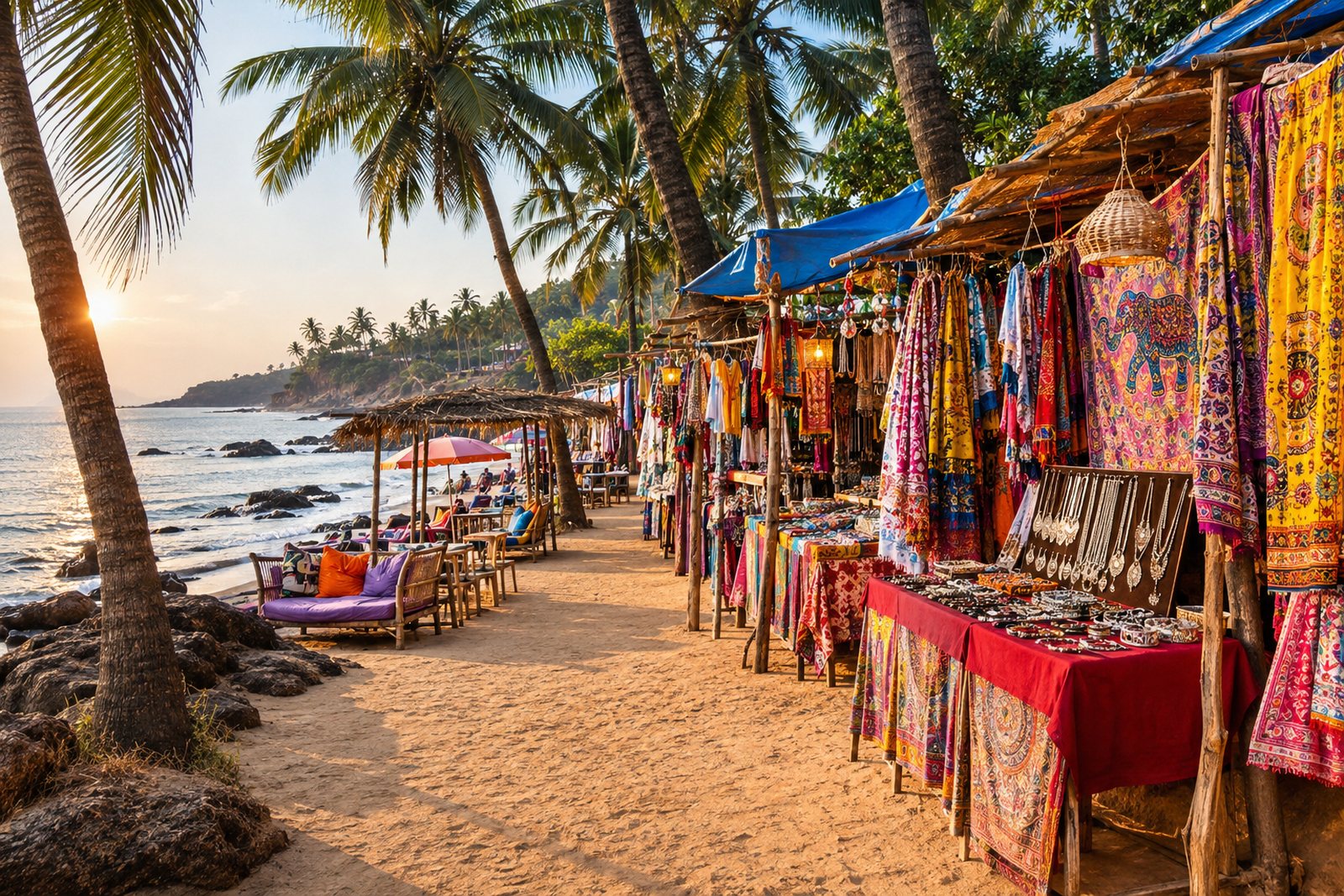
Travellers began gathering to sell or swap their belongings: a camera, a pair of jeans, a guitar, books, jewellery picked up in Afghanistan or Rajasthan. It was less a market than a beach-side swap meet among friends. It came to settle on Wednesday, and the meeting place became the open ground near Anjuna beach.
Who started it? Local lore often credits an American traveller known as "Eight Finger Eddie", one of the earliest foreigners to settle in Anjuna, with getting the gatherings going. Like most hippie-era stories, the details depend on who is telling it. What is clear is that by the 1970s the Wednesday market had become a fixture.
Then local sellers arrived, and the market grew up. Lamani women from Karnataka in their mirror-work skirts and heavy silver. Traders from Kashmir with shawls and carpets. Tibetan stalls, Rajasthani textiles, spice sellers, Goan cashew. The swap meet turned into a proper market.
Did you know? The hippie trail effectively closed in 1979. The Iranian Revolution and the Soviet invasion of Afghanistan, both that year, made the overland route through those countries unsafe. Travellers still came to Goa, but now mostly by plane.
How Anjuna and Vagator changed
From the 1980s, the cheap flights brought a new crowd, and the beach parties grew louder. North Goa got a reputation for all-night music, and in the 1990s Goa even gave its name to a style of electronic music, Goa trance. Later, noise rules began to limit late-night outdoor music.
A word every family should hear clearly here. Drugs are illegal in India. The law, the NDPS Act, carries severe penalties including long prison terms, and it applies fully to tourists. Goa's police take it seriously. Do not buy, carry or accept anything, however casual the offer sounds.
Today Anjuna and Vagator are much busier and more family-friendly than their reputation suggests. Cafes, guesthouses and shacks line the roads. The red cliffs of Vagator lead up to Chapora Fort, which a generation of Indians first saw in the 2001 film Dil Chahta Hai. Sunset there is a scene of its own.
To fit Anjuna, Vagator and the rest of North Goa into one trip, BellaSafar's Goa Classic Plus package gives you a comfortable stay with transfers and sightseeing days you can plan around a Wednesday.
How to visit the Anjuna flea market today
- Location: Near Anjuna beach in North Goa, around 20 km from Panjim. It is around 45 minutes to 1 hour from Mopa airport and longer from Dabolim, depending on traffic.
- When: Wednesdays during the tourist season, roughly November to March or April. It does not run in the monsoon. Days and timings change, so check locally.
- Best time: November to February. Go in the late afternoon, when the sun is softer and the stalls are fully set up.
- Bargaining: Expected. Start well below the asking price and stay friendly.
- Dress: Light cotton, a cap and comfortable footwear. The ground is uneven and dusty.
- Safety: Keep phones and wallets in a zipped bag, keep children close in the crowd, and avoid any offer of drugs.
- Combine it with: Sunset at Chapora Fort, a swim at Vagator or Anjuna, or the Saturday night market in Arpora if your dates allow.
The market that outlived the trail
The overland buses stopped a long time ago. Most of those first travellers went home, grew up, grew old. But every Wednesday in season, the ground near Anjuna beach still fills with sellers, buyers and the smell of incense and fried snacks, and somewhere a guitarist is still playing for nobody in particular. It is a small, living leftover of a very strange chapter in Goa's story, and a fun afternoon for the whole family.
Planning your trip? Read our Goa trip plan or browse all Goa holiday packages.
Frequently asked questions
What is the history of the Anjuna flea market?
The Anjuna flea market grew out of gatherings in the hippie era, when foreign travellers who had reached Goa on the overland hippie trail sold or swapped their belongings to fund their stay. By the 1970s it was a regular Wednesday market, and local and Indian traders later joined.
Which day is the Anjuna flea market held?
The Anjuna flea market is held on Wednesdays during the tourist season, roughly November to March or April. It does not run during the monsoon, and timings can change, so check locally.
What was the hippie trail to India?
The hippie trail was an overland route used by young Western travellers in the 1960s and 70s, running from Europe through Turkey, Iran, Afghanistan and Pakistan into India and Nepal. It largely ended in 1979.
Why did hippies come to Goa?
Goa offered warm seas, quiet beaches, cheap rooms in village homes, simple food and a relaxed, open culture. Calangute and Baga came first, and later Anjuna and Vagator became the main hippie hangouts.
Is Anjuna safe for families?
Yes, Anjuna and Vagator are popular with families today. Keep valuables secure in crowds and stay away from drugs, which are illegal in India and carry severe penalties for tourists too.