Pandavleni Caves Nashik: Buddhist Caves Called the Pandavas' Home
Monks carved them about two thousand years ago; locals said the Pandavas lived here. The story of Pandavleni caves in Nashik and how to climb up today.
The Pandavas never lived here. Nobody in Nashik really minds. Ask an auto driver for Pandavleni and he will nod, point at the hill on the edge of the city, and say something like, "Pandav log yahan rahe the, saab." Then he will drop you at the foot of a long staircase going up a rocky slope, and the real story begins.
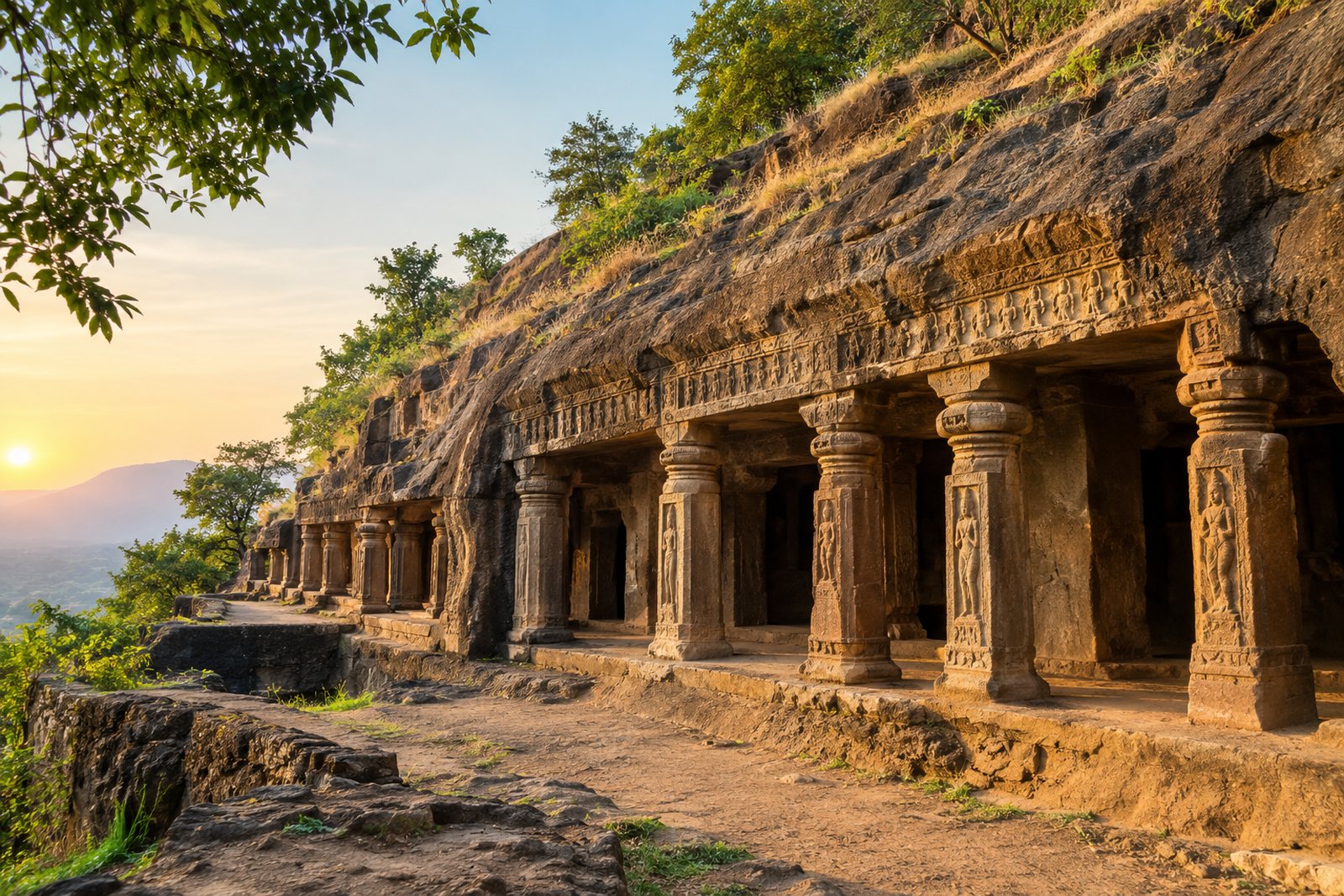
These are the Pandavleni caves, also written Pandu Lena, carved into Trirashmi hill by Buddhist monks around two thousand years ago. Here is who made them, how they got a Mahabharata name, and how to visit.
Monks on a hill above a trade route
Long before Nashik became the city of Kumbh and Godavari ghats, it sat on old trade routes linking the ports of the western coast with the Deccan. Merchants travelled these roads with caravans of goods. So did Buddhist monks.
Monks needed shelter during the monsoon months, when travelling stopped. So, on a hillside of hard basalt above the route, they began carving. One cave at a time, with chisels and patience, over generations. Historians generally place the work between around the 2nd century BCE and the early centuries CE.
What they made is still there: a row of caves cut into the cliff, most of them viharas, rooms where monks lived and studied, around a central hall. One is a chaitya, a prayer hall with a stupa at the end and a beautifully carved entrance.
Kings, queens and merchants who paid for it
The best part of Pandavleni is not the carving. It is the writing.
Many caves have inscriptions in Brahmi script, recording who donated what. Some are royal. A famous inscription is linked to Queen Gautami Balashri, mother of the Satavahana king Gautamiputra Satakarni, recording a gift of a cave and praising her son. Others record the family of Nahapana, a ruler of the Western Kshatrapas, the rivals of the Satavahanas. Two dynasties that fought each other both paid for caves on the same hill.
And then there are the small donors. Merchants, a fisherman, a lay devotee. Each wanted their gift remembered, and two thousand years later, it is.
Did you know? Historians use the Pandavleni inscriptions as a key source for the Satavahana period. A visit here is literally a walk past pages of ancient Indian history, written in stone.
So where do the Pandavas come in?
That part is pure folk naming. Across India, caves and ruins whose builders were forgotten have often been linked to the Pandavas, who in the Mahabharata spent years in exile in forests. "Lena" itself is an old word for a cave. Pandu Lena, the caves of Pandu's sons, sounded right to people who saw these strange rooms on a hill.
So the name is a legend, not history. But it shows how deeply the Mahabharata lives in everyday Indian imagination. Even monks' cells became part of the story.
What the climb is like
The steps start gently and keep going. There are breaks, shade in places and a few chai and water sellers near the bottom. Halfway up, Nashik spreads out below you, with the highway on one side and the city on the other.
At the top, the cave fronts are cool even on warm days. Walk slowly. Look for the carved pillars with animal figures, the small Buddha images added in later centuries, the rock-cut benches where monks once sat. Keep your voice down. Sound carries beautifully in the halls.
The Nashik Darshan trip covers Pandavleni with Trimbakeshwar and the Panchavati ghats over two nights. The Nashik & Shirdi plan adds a day for Sai Baba and Shani Shingnapur, while the Nashik Wine & Temples trip mixes the caves and temples with a day in the vineyards.
How to visit Pandavleni today
- Location: On the edge of Nashik city, close to the Mumbai-Agra highway.
- Time needed: Around one and a half to two hours including the climb.
- Best time: The hill looks green just after the monsoon; winter mornings are pleasant. Avoid summer afternoons.
- Entry: It is an ASI-protected site; tickets and timings can change, so check locally.
- For elders: The steps are many. Go early, take breaks and carry water. Some may prefer to stay at the park below.
- Combine with: The Dadasaheb Phalke memorial park at the foot of the hill, Panchavati and Kalaram temple, and Trimbakeshwar.
Our tip: Go in the early morning. The sun lights up the cave fronts, the steps are cool, and you will share the caves with a few walkers instead of school groups.
A hill that kept two stories
Pandavleni holds two stories at once. One is written on its walls, of monks, queens and merchants. The other is in its name, a gift from ordinary people who looked at these caves and saw the Pandavas. Both are Indian in their own way.
Planning a Nashik trip? Read about the Kalaram Temple Satyagraha or browse all Nashik holiday packages.
Frequently asked questions
Who built the Pandavleni caves?
They were carved by Buddhist monks and their patrons roughly two thousand years ago. Inscriptions in the caves record donations by Satavahana royals, Western Kshatrapa families, merchants and ordinary devotees.
Did the Pandavas live in Pandavleni caves?
No. The Pandava link is a local popular belief and name. The caves are Buddhist monasteries and a prayer hall carved centuries after the age the Mahabharata describes.
How many caves are there in Pandavleni?
There are around two dozen caves, most of them viharas, or monks' living quarters, and one chaitya hall with a stupa used for prayer.
How long is the climb to Pandavleni caves?
The climb is up a long flight of steps and usually takes around 20 to 30 minutes at an easy pace. Carry water and wear good shoes.
What is near Pandavleni caves in Nashik?
The Dadasaheb Phalke memorial park is at the foot of the hill. Panchavati, Kalaram temple and Trimbakeshwar Jyotirlinga can be combined on a Nashik trip.