Kaba Gandhi No Delo: Gandhi's Childhood Home in Rajkot
Before he was the Mahatma, he was a shy schoolboy in a Rajkot lane. A visit to Kaba Gandhi No Delo, the house where Mohandas grew up.
Here is a boy you would not have noticed. Thin, big ears, painfully shy. He runs home from school the moment classes end, because he is afraid someone might talk to him. He is not good at sports. His handwriting, he will later admit, is bad.
His name is Mohandas. The house he runs home to is in a narrow lane of Rajkot, and Gujarat still calls it Kaba Gandhi No Delo, the house of Kaba Gandhi. This is the story of that house, the boy who grew up in it, and how to add a quiet hour here to your Saurashtra trip.
Who was Kaba Gandhi?
Kaba was the everyday name of Karamchand Gandhi, Mohandas's father. He came from a family of diwans, chief administrators to the small princely states of Kathiawar. He had served in Porbandar, where Mohandas was born in 1869, and later in Rajkot.
He was, by his son's own account, honest, short-tempered, generous, and not very interested in money. He had little formal education but a lot of practical wisdom. Rajkot's rulers trusted him. And so, when the boy was still small, the family moved from Porbandar's sea air to Rajkot's dry heat.
The house in the lane
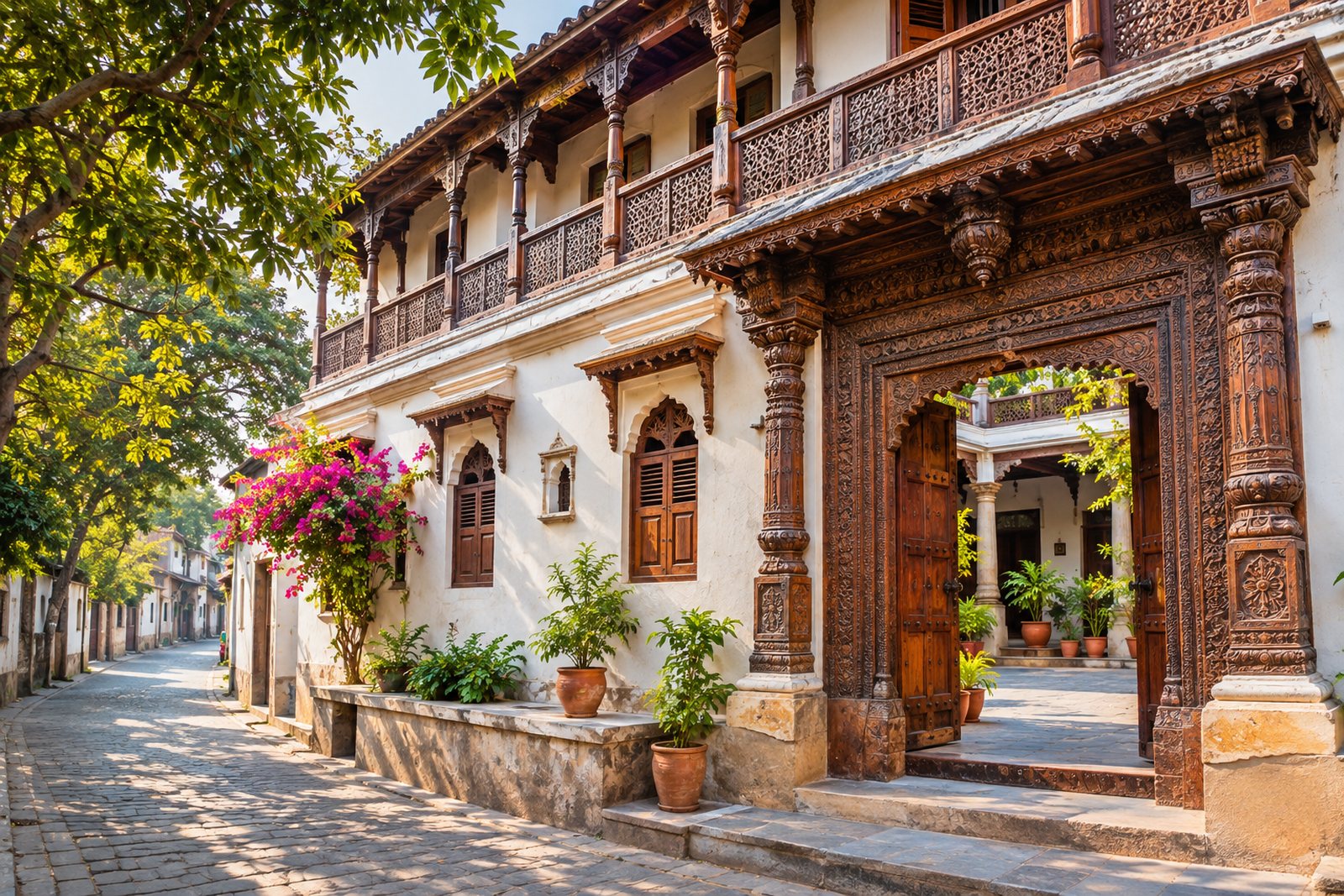
The house was built for Karamchand in the later 19th century, in the traditional Kathiawadi style. Picture a solid two-storey home around an inner courtyard. Wooden doors. Rooms opening onto the chowk. A place full of relatives, servants, visitors with petitions, and a very religious mother at its heart.
That mother was Putlibai. She fasted often, sometimes for long stretches, and visited the temple every day. Mohandas would later write that the outstanding impression she left on him was of saintliness. A lot of what the world later saw in him, the fasting, the stubborn self-discipline, started in this courtyard.
Shravan, Harishchandra and a confession
Two stories from his boyhood stayed with him for life, and he tells them in his autobiography.
The first was about Shravan, the son from the Ramayan who carried his blind parents on a kavad across his shoulders. Young Mohandas saw a picture of it and was deeply moved. The second was the play about King Harishchandra, the king who would not tell a lie whatever it cost him. Mohandas watched it, then acted it out again and again by himself. "Why should not all be truthful like Harishchandra?" he asked himself. It is a child's question. He spent the rest of his life trying to answer it.
He was not a saint at fourteen, and he was honest enough to say so. In those Rajkot years, he later admitted, he smoked secretly, stole a little, and even ate meat in secret with a friend, which was a big deal in a devout Vaishnav family. Then he wrote out a full confession and handed it to his father, who was ill and lying in bed. Karamchand read it, did not shout, and simply wept. Mohandas wrote that those tears cleaned him.
That moment happened in this house.
Did you know? Karamchand Gandhi died in Rajkot in 1885, when Mohandas was about sixteen. The boy had been nursing him every evening, and the guilt of not being at his bedside at the very last moment stayed with him for life.
From Rajkot to London
Mohandas studied at the Alfred High School in Rajkot, an average student by most accounts. In 1888, still a teenager and already married to Kasturba, he left for London to study law. Many people in his community opposed the trip across the sea. He went anyway. Everything that followed, South Africa, the salt march, the freedom movement, started with a shy boy walking out of a Rajkot lane.
What you see at Kaba Gandhi No Delo today
Today the house is a small memorial and museum. Don't expect grand halls. Expect rooms with photographs, panels on his life, a few objects, and the courtyard where the family once sat. It is quiet. On a weekday morning you may have it nearly to yourself, apart from a school group in uniform reading the panels aloud.
Nearby, the old Alfred High School building has been turned into a larger Gandhi museum, so the two make a natural pair.
Rajkot is the starting point for most Saurashtra trips. BellaSafar's Dwarka Somnath Yatra begins here before heading to Dwarka and Somnath, Gir Somnath Diu goes from Rajkot to the lions of Gir and the coast, and the longer Saurashtra Darshan adds Ahmedabad, Dwarka, Somnath and Gir. Ask us to fit an hour for this house into the Rajkot day, as per your itinerary.
How to visit Kaba Gandhi No Delo
- Where: In the old part of Rajkot, off Ghee Kanta Road, a short drive from the railway station. Rajkot has an airport outside the city.
- Best time: October to March. Rajkot summers are very hot.
- How long: About 45 minutes to an hour; another hour if you add the Alfred High School museum.
- Timings: Closed days and hours can change. Check locally.
- Respect: It is a memorial. Keep voices low and follow photography rules at the entrance.
- Combine with: The Alfred High School museum, Rajkot's evening snack streets, and an early start next day towards Dwarka or Gir.
Our tip: If you are travelling with children, tell them the Harishchandra story the night before. Then let them stand in the courtyard and imagine the boy acting it out on his own. They will remember this house far longer.
Why a small house matters
We usually meet Gandhi as a statue, a photograph on a wall, a face on a note. Here you meet him as a nervous boy who made mistakes, owned up, and watched his father cry. It is a much more human Gandhi, and somehow a much bigger one.
Heading on to the coast? Read our Dwarka Somnath yatra guide or browse all Rajkot holiday packages.
Frequently asked questions
What is Kaba Gandhi No Delo?
It is the house in Rajkot where Mahatma Gandhi spent much of his childhood. It was the home of his father Karamchand Gandhi, known as Kaba Gandhi, who served as diwan of Rajkot. It is now a small memorial museum.
What does Kaba Gandhi No Delo mean?
In Gujarati it means 'the house of Kaba Gandhi'. Kaba was the popular name of Gandhi's father, Karamchand Gandhi.
How old was Gandhi when he moved to Rajkot?
Gandhi was born in Porbandar in 1869 and moved to Rajkot as a small boy when his father took up service there. He lived in Rajkot through his school years until he left to study law in London in 1888.
Which school did Gandhi attend in Rajkot?
He studied at the Alfred High School in Rajkot. The old school building has since been turned into a Gandhi museum.
Is there an entry fee at Kaba Gandhi No Delo?
It is a small memorial and visiting rules, timings and closed days can change. Check locally in Rajkot before you go.