Rajkot to Dwarka: Half-Day Drive and Bet Dwarka Plan
Ganthiya for the road, a Jamnagar halt, Dwarkadhish aarti by evening and Bet Dwarka over the new bridge: a complete Rajkot to Dwarka road trip plan.
Every Rajkot road trip begins with two things: a paper packet of hot ganthiya and an argument about what time to leave. Papa wants to go at six. Mummy wants to go after the puja. The kids want to go after breakfast. The driver, who has done this drive hundreds of times, quietly says nine is fine, and somehow he is right.
Rajkot to Dwarka is one of the easiest pilgrim drives in Gujarat: half a day on good roads through the heart of Saurashtra, with Jamnagar as the natural halfway stop and Dwarkadhish's evening aarti waiting at the end. Here is the road, the breaks, and a simple plan for Bet Dwarka the next day.
The route at a glance
- Distance: Roughly 225 to 235 km, depending on the exact start point.
- Driving time: Around four and a half to five hours, plus stops.
- Route: Rajkot to Jamnagar, then along the highway through Khambhalia to Dwarka.
- Road: Mostly good highway, with slower stretches through towns.
- Best months: October to March. Summer afternoons on this road are seriously hot.
Rajkot to Jamnagar: the first stretch
The first leg to Jamnagar takes around two hours, a little more if Rajkot's traffic is in a mood. The land opens out fast once you leave the city. Cotton and groundnut fields, a few windmills, villages with whitewashed temples, and highway hotels where trucks pull in for chai.
If you have a free morning before leaving, Rajkot has its own small pilgrimage: the house where Mahatma Gandhi spent part of his childhood, known locally as Kaba Gandhi no Delo. Families on a longer trip often fit it in on the way out.
Jamnagar: lake, temple and a snack break
Jamnagar is the perfect halfway halt. Head to the lake in the old city, with its round palace in the middle, and walk the promenade for a bit. Then visit the Bala Hanuman temple on the lake's edge, known for a continuous chanting of "Shri Ram, Jai Ram, Jai Jai Ram" that has carried on, day and night, since the 1960s. Stand in the hall for a few minutes and you will catch yourself humming along.
Did you know? The non-stop Ram dhun at Jamnagar's Bala Hanuman temple has been going for so many decades that it is widely recognised as one of the longest continuous chants in the world.
Jamnagar is also famous for bandhani, the tie-dye fabric of Gujarat, so if anyone in the family wants a dupatta or saree, the old market is the place. And this is your lunch stop. A Kathiawadi thali with rotla, kadhi, ringan nu shaak and a glass of chaas will keep you going till Dwarka. Jamnagar's kachori is a local favourite too.
Jamnagar to Dwarka: the last leg
From Jamnagar it is roughly two and a half to three hours to Dwarka. You pass the big industrial belt outside the city, and then the road becomes quieter and flatter, through Khambhalia, a small town that makes a good tea and restroom stop.
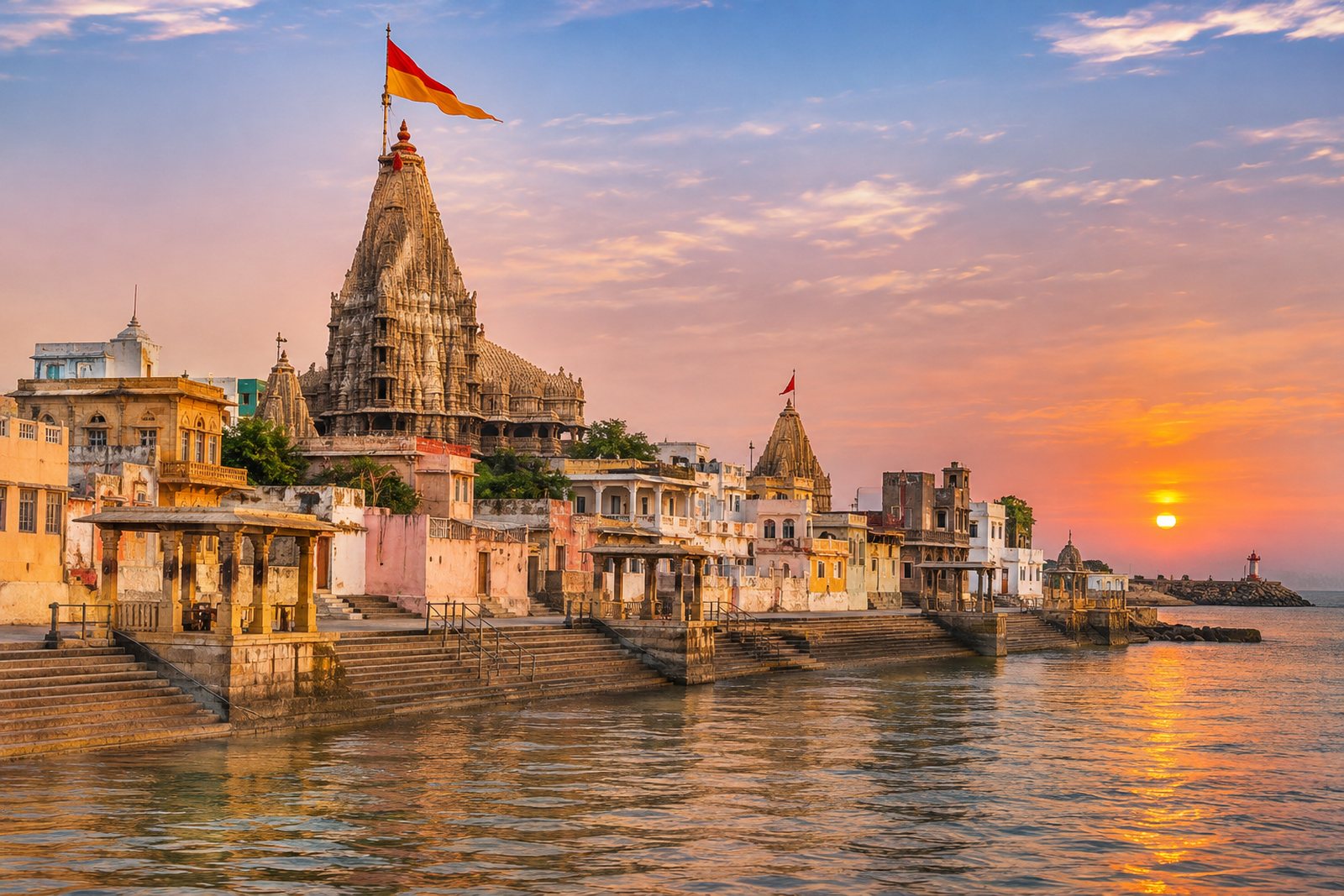
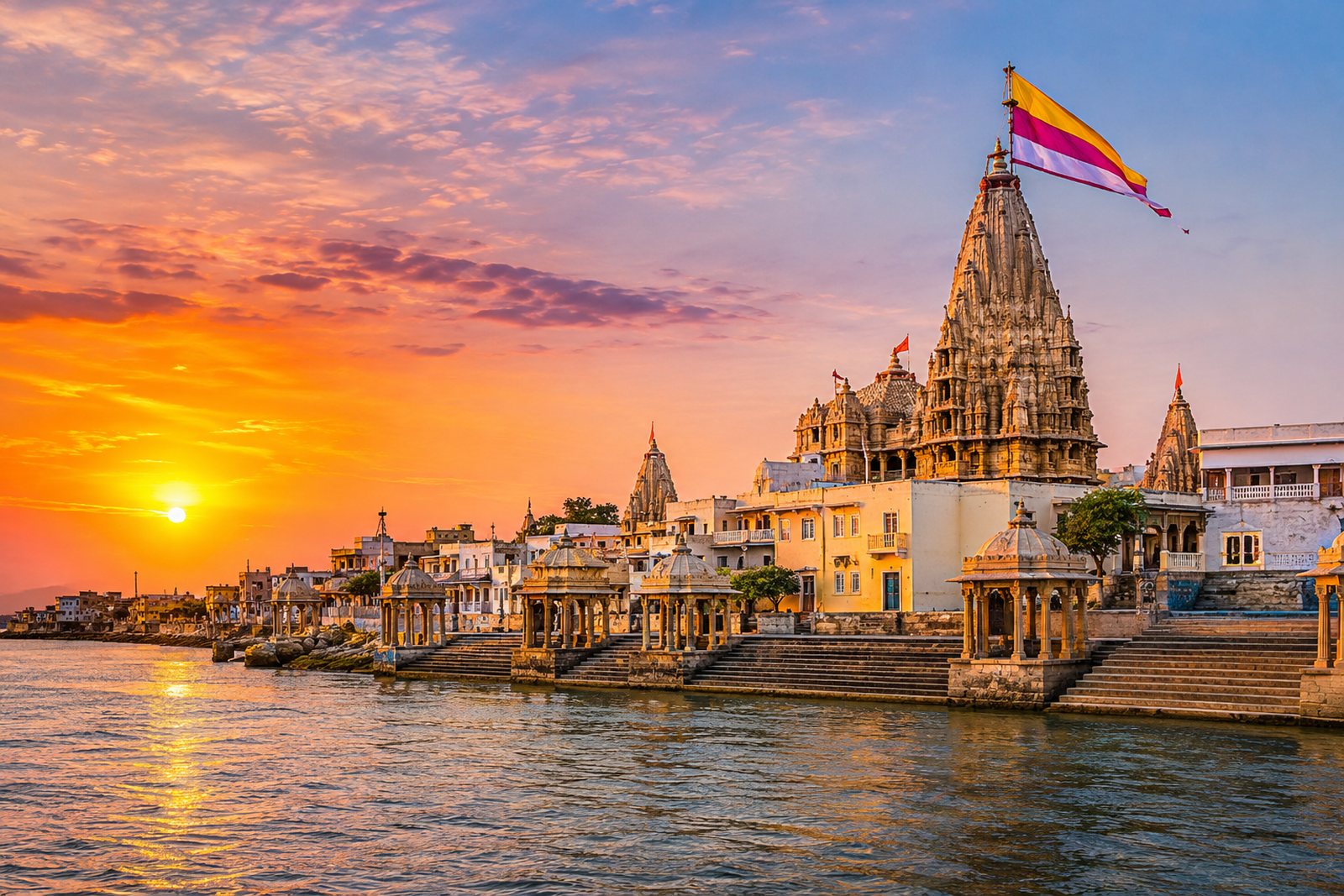
In the last hour you start to feel the sea. The air gets salty, the land turns scrubby, and then you see it: the tall shikhar of the Dwarkadhish temple with its huge flag rising above the town.
Arriving in Dwarka: Gomti Ghat and the evening aarti
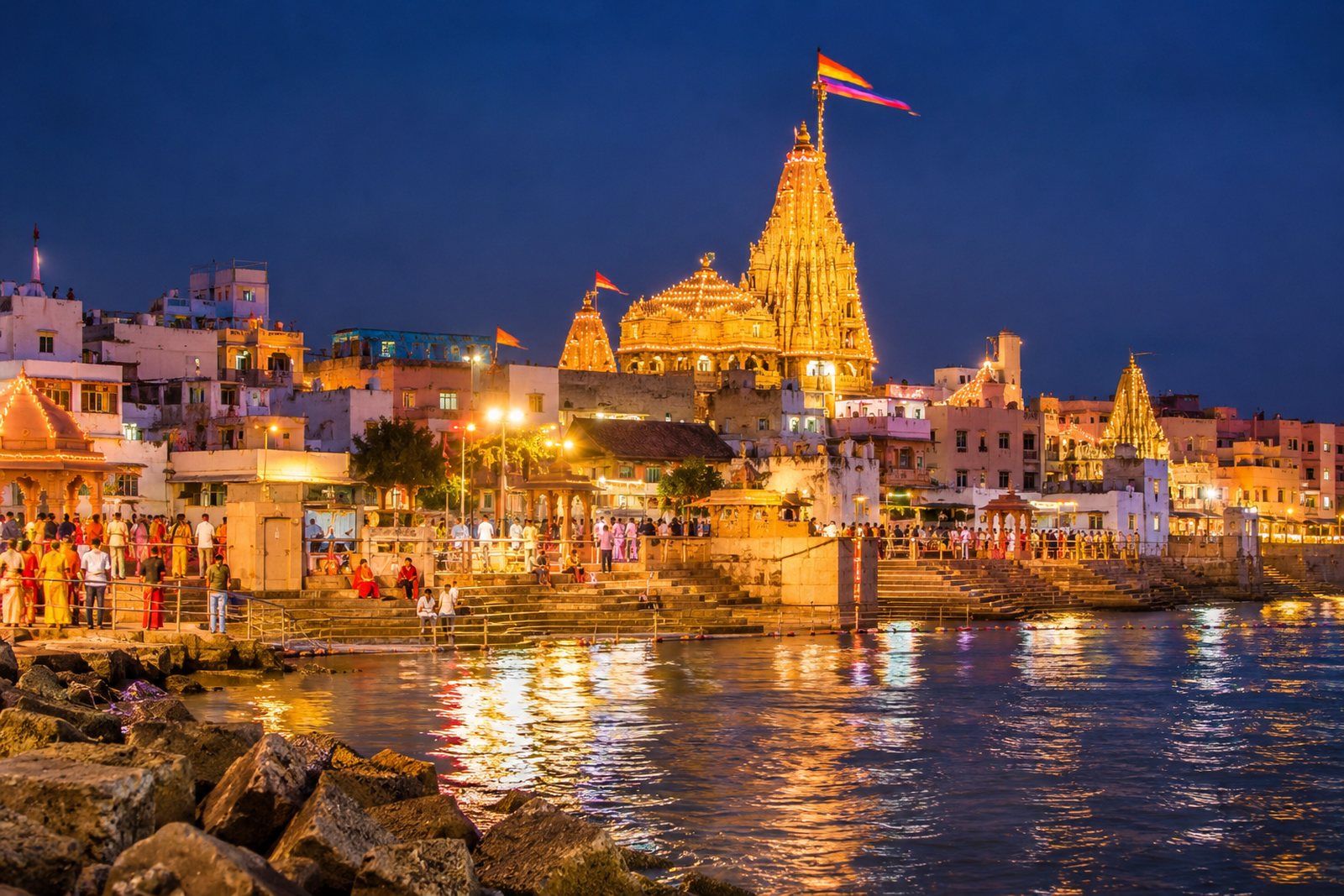
Plan to reach by late afternoon. Check in, freshen up, and walk to Gomti Ghat, where the Gomti meets the Arabian Sea. From the ghat, a flight of steps leads up to the temple. Devotees often enter by one gate and leave by another; local guides will tell you the names and the stories behind them.
The Dwarkadhish temple, also called Jagat Mandir, is one of the Char Dham, and its flag is changed several times a day. Families sponsor the flag well in advance. The evening aarti, with drums, bells and the cry of "Jai Dwarkadhish", is the right way to end the drive. Mobile phones and bags may not be allowed inside, and timings change for festivals, so check with the temple administration locally.
Day two: Nageshwar, Rukmini and Bet Dwarka
- Nageshwar Jyotirlinga: On the road towards Okha, with a large Shiva statue outside. Read the story in our Nageshwar Jyotirlinga history.
- Rukmini temple: A short drive outside town. Local legend says Rukmini lives apart from Krishna here because of a sage's curse.
- Bet Dwarka: The island linked to Krishna's home, now reached by road over the Sudarshan Setu, the cable-stayed bridge from Okha opened in 2024.
- Shivrajpur beach: A Blue Flag beach near Dwarka for a quiet hour by the sea.
Our tip: Do Bet Dwarka early. Temples there may close in the afternoon, and the road back to Dwarka gets busier as the day goes on.
Where to halt if you are not in a hurry
If you have seniors or small kids, split the drive with a night in Jamnagar. You get the lake in the evening light, a relaxed temple visit, and a fresh morning for the second half. Otherwise, the drive is comfortable in a single day.
Dwarka Somnath Yatra starts from Rajkot and gives you two nights in Dwarka and two in Somnath, with a Diu day trip, as per the package itinerary. Saurashtra Darshan begins with a night in Rajkot and adds Gir to the end, and Gujarat Grand starts from Ahmedabad with its old city and stepwells.
The drive to Dwarka is not difficult. What stays with you is the end of it: that first look at the flag over the town, and the noise of the aarti rising over the sea.
Coming from further away? Read our guide to Ahmedabad to Dwarka by road, or browse all Dwarka holiday packages.
Frequently asked questions
How far is Dwarka from Rajkot by road?
Roughly 225 to 235 km, around four and a half to five hours of driving via Jamnagar and Khambhalia, plus stops.
What is the best stop between Rajkot and Dwarka?
Jamnagar, about two hours from Rajkot, for its lake, the Bala Hanuman temple, bandhani shopping and lunch.
Can I reach Bet Dwarka by road now?
Yes. The Sudarshan Setu bridge from Okha, opened in 2024, connects Bet Dwarka by road.
Can Dwarka be done as a day trip from Rajkot?
It is possible but tiring. A night in Dwarka lets you attend the evening aarti and see Bet Dwarka and Nageshwar the next day.
Are mobile phones allowed inside the Dwarkadhish temple?
Rules can change and phones and bags are often restricted. Check with the temple administration locally.