Aina Mahal Bhuj: The Palace of Mirrors Built by a Sailor Craftsman
A Kutchi sailor learned European crafts far from home, came back and built his king a hall of mirrors in Bhuj. The Aina Mahal story, and how to visit.
Imagine a young man from Kutch, standing on the deck of a ship that is going down. The sea he knows is the Gulf of Kutch, warm and shallow. This one is wide and strange. He does not drown. He is pulled out of the water by foreign sailors and carried away to a country he has barely heard of.
That, more or less, is how the story of Aina Mahal in Bhuj begins, at least as Kutch has always told it. The young man was Ram Singh Malam. Years later he would build his king a palace of mirrors. Here is how a shipwreck turned into a hall of glass, and how to see what remains of it today.
Kutch, the land that faced the sea
Before we meet Ram Singh properly, remember what Kutch was in the 18th century. Not a dusty corner of Gujarat. It was a kingdom that lived by the sea. Mandvi's shipbuilders sent wooden vessels to Arabia and East Africa. Kutchi traders knew Muscat and Zanzibar better than they knew Delhi. Ideas, objects and people came and went by ship.
So it is not so strange that a Kutchi boy ended up in Europe.
Seventeen years away, according to the story
The commonly told account says Ram Singh was rescued by a Dutch ship and taken to the Netherlands. There, over many years (the story usually says around seventeen or eighteen), he learned crafts no one in Kutch knew: glass blowing, enamelling, tile making, iron casting, clock making. When he finally found his way back home, he brought those skills with him.
Exact years and details vary depending on who is telling it, and historians have only fragments. What is clear is that a Kutchi craftsman with European training was working at the court of Bhuj in the mid-18th century, and that the ruler, Rao Lakhpatji, was exactly the kind of king who would want him.
A king who loved beautiful things
Rao Lakhpatji was a patron of music, poetry and crafts. He is remembered for a school of poetry in Bhuj and for his love of fine objects. Give a king like that a man who can make glass, tiles and clocks, and you get a palace that no one else in western India had.
Aina Mahal, the "palace of mirrors", went up in the 1750s, beside the older royal buildings of Bhuj.
What was inside
Step in and the light does strange things. Walls covered with mirror glass and gilt. White marble set with glass. Venetian-style glass lamps. Blue-and-white tiles that look straight out of a Dutch house. Paintings of European scenes hung beside Kutchi ones.
The heart of it was the king's pleasure hall. In the middle was a raised platform surrounded by a shallow pool, with fountains. Here, the story goes, Rao Lakhpatji sat to listen to music and poetry, with water around him and candlelight flickering off a thousand mirrors. In a desert kingdom, that is not just luxury. It is a statement.
Did you know? Some of the clocks Ram Singh is linked with were made to show not just the time but also the Hindu calendar and phases of the moon, a European machine taught to keep Indian time.
26 January 2001
Bhuj does not tell this part easily. On the morning of Republic Day in 2001, a massive earthquake hit Kutch. Bhuj was close to the centre. Thousands of lives were lost across the region, and the old city was badly broken.
The palace complex took heavy damage. Walls cracked, parts collapsed, and treasures were buried under rubble. In the years after, sections of Aina Mahal were repaired and reopened as a museum, but not all of it came back. When you visit, you see a building that survived, not one that was frozen in time.
That makes it more moving, not less.
Around the palace in Bhuj
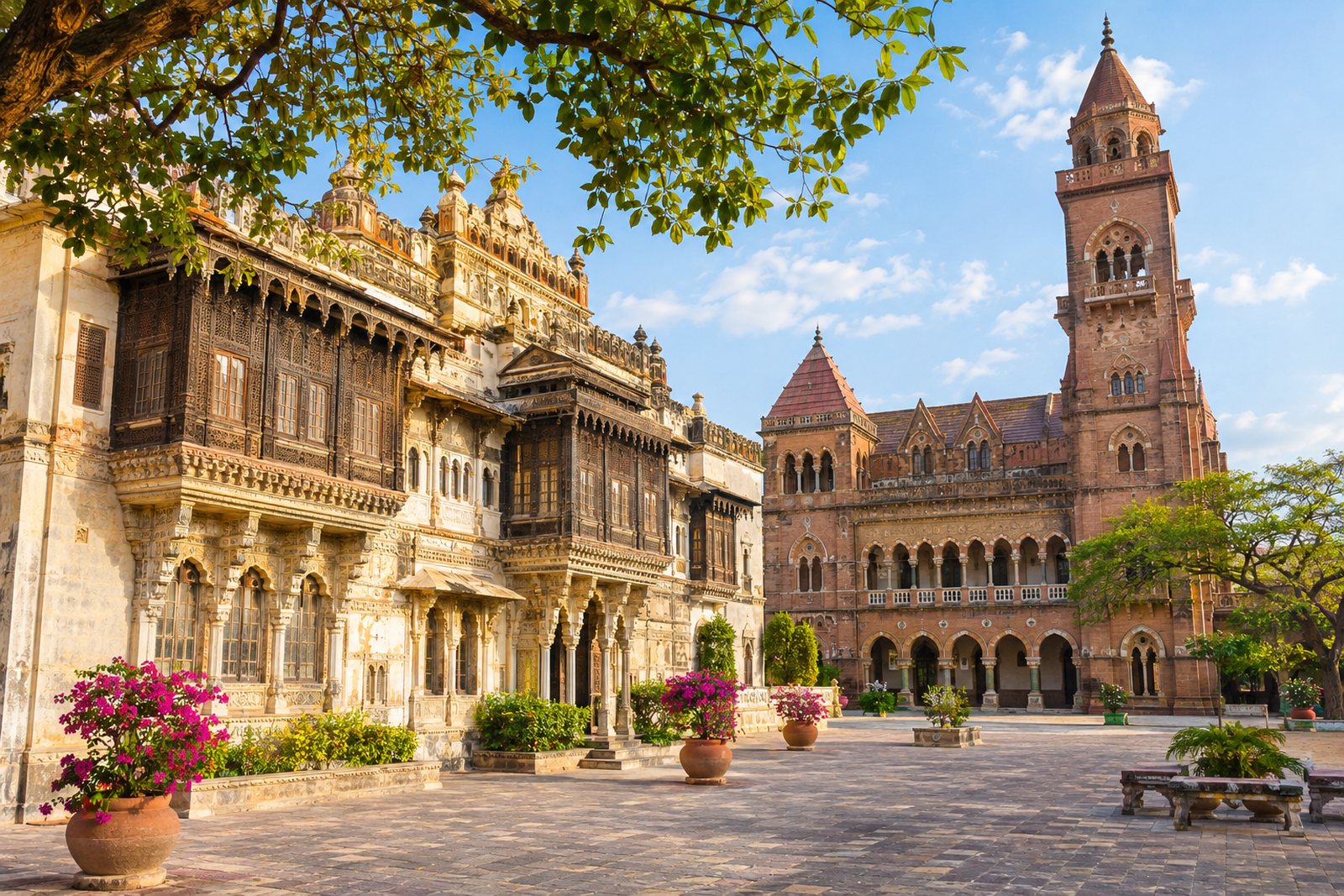
- Prag Mahal, right next door, built in the 19th century in European Gothic style, with a tall clock tower and a big darbar hall.
- Hamirsar Lake in the middle of the old city, a pleasant evening walk.
- Kutch Museum, one of the oldest museums in Gujarat, with textiles, coins and old inscriptions.
- Bhujodi and the craft villages, for weaving, block printing and embroidery, just outside town.
- Dholavira, the Harappan city on Khadir Bet, and the White Rann at Dhordo, further north.
For a short trip, Kutch & White Rann gives you three nights based in Bhuj, with the palaces and the Rann as per the package itinerary. If you want Dholavira and a night near the salt desert too, Kutch Heritage & White Rann covers Bhuj, Dholavira and Dhordo in four nights, and Kutch Heritage & White Rann from Ahmedabad starts with a night in Ahmedabad.
How to visit Aina Mahal today
- Where: In the old palace complex in central Bhuj, close to Hamirsar Lake and Prag Mahal. Bhuj has a domestic airport and a railway station.
- Best time: November to February. This is also the White Rann season, roughly matching the Rann Utsav months, so book stays early.
- How long: About an hour for Aina Mahal, another hour for Prag Mahal.
- Timings and access: Open days, tickets and which rooms are accessible can change, especially with repair work. Check locally.
- Inside: Some floors are uneven and stairs are steep. Go slow with elders.
- Photography: Rules vary room to room; ask at the entrance.
Our tip: Visit Aina Mahal in the afternoon, then walk to Hamirsar Lake for sunset. You will have spent the day with a craftsman who loved light, so end it with the light on the water.
A palace made by someone who came home
Most palaces are stories about kings. This one is just as much about a craftsman who went very far away, almost by accident, and chose to come back. Every mirror on those walls is, in a way, a piece of his memory of the world. Kutch kept it, broke a little with it, and is still holding on.
Planning the Rann too? Read our Rann of Kutch trip guide or browse all Bhuj holiday packages.
Frequently asked questions
Who built Aina Mahal in Bhuj?
Aina Mahal was built in the mid-18th century for Rao Lakhpatji, ruler of Kutch. It was designed by Ram Singh Malam, a Kutchi craftsman who had learned European crafts during years abroad.
Who was Ram Singh Malam?
He was a craftsman and sailor from Kutch who, according to the commonly told account, spent many years in Europe, mainly in the Netherlands, learning glass work, enamelling, tile making and clock making before returning to Kutch.
Was Aina Mahal damaged in the 2001 earthquake?
Yes. The 2001 Gujarat earthquake badly damaged Aina Mahal and the old palace complex in Bhuj. Part of it was restored and reopened as a museum, while some areas remain closed.
What is the difference between Aina Mahal and Prag Mahal?
Aina Mahal is the older 18th century palace famous for its mirror work. Prag Mahal next door was built in the 19th century in a European Gothic style and is known for its tall clock tower and darbar hall.
Is Aina Mahal open on all days?
Opening days and timings change, and some sections may be under repair. Check locally in Bhuj before you plan your visit.